
Thursday, March 8, 2012

Monday, March 5, 2012
A Thousand Splendid Suns
“A Thousand Splendid Suns recounts the experiences and emotions of two Afghani women, Mariam and Laila, whose lives become entangled with the history of recent wars in their country. Mostly bleak and heartrending, their story does offer the promise of hope and happiness in a land ravaged by warfare, gender conflicts, and poverty.
Wednesday, February 22, 2012
Interpretation of the POEM
人を夢とや
思い知るらむ
住み捨て市
その輪誇張の
宿りにて
This is the original poem.
思い知るらむ
住み捨て市
その輪誇張の
宿りにて
That man's life is but a dream -
is what we now come to know.
Its house abandoned,
the garden has become home
to butterflies
is what we now come to know.
Its house abandoned,
the garden has become home
to butterflies
This is the original poem.
Thursday, February 16, 2012
AP Test Write up
- What was easy/expected?
- What was difficult/unexpected?
- What did you learn about the AP questions?
- What did you learn about your own performance under pressure?
- How will this experience influence your preparation for the actual exam?
Tuesday, February 14, 2012
Notes on Tales of Two Cities Lecture
· 3rd city of Manchester in tales of two cities
· 1857- dickens and friends wrote “frozen deep”
o Inspired by journey to northwest passage
· Production was done (wanted to be done by professional actors) not friends and family
Wednesday, February 1, 2012
Study Guide: The Great Expectation Part One
Study Guide Questions: Solved
Who was Charles Dickens?
I know teachers hate students using Wikipedia but since I don’t know Dickens personally myself, there’s no option.
Charles John Huffam Dickens: 7 February 1812 – 9 June 1870) was an English novelist, generally considered the greatest of the Victorian period. Dickens enjoyed a wider popularity and fame than had any previous author during his lifetime, and he remains popular,
I know teachers hate students using Wikipedia but since I don’t know Dickens personally myself, there’s no option.
Charles John Huffam Dickens: 7 February 1812 – 9 June 1870) was an English novelist, generally considered the greatest of the Victorian period. Dickens enjoyed a wider popularity and fame than had any previous author during his lifetime, and he remains popular,
The Great Expectation
The Great Expectation by Charles Dickens is a fictional story about a boy named Philip Pirrip who much rather be known as "Pip". The introduction is quite disheartening; Dickens presents a strong sense of death wandering around the old graveyard where Pip meets a threatening old man. According to Dickens' biography, he grew up miserably through his childhood and also parentless so his life similarly represents Pip's life. Assuming there will be a turn on the table, something of great expectation is bound to occur.
Sunday, January 29, 2012
Literary Analysis #4
1. Briefly summarize the plot of the novel you read.
2. Succinctly describe the theme of the novel. Avoid clichés.
3. Describe the author's tone. Include three excerpts that illustrate your point(s).
4. Describe five literary elements/techniques you observed that strengthened your understanding of the theme and/or your sense of the tone. Include three excerpts that will help your reader understand each one.
Joy Luck Club by Amy Tan
1. The Joy Luck Club by Amy Tan contains many stories about Chinese immigrant mothers and their children who are born and raised in America. One of the main characters, Jing-mei Woo, took her mother’s place playing mahjong which was in San Francisco. The club members of this Joy Luck Club all share their stories and pass them on to their American children.
2. Succinctly describe the theme of the novel. Avoid clichés.
3. Describe the author's tone. Include three excerpts that illustrate your point(s).
4. Describe five literary elements/techniques you observed that strengthened your understanding of the theme and/or your sense of the tone. Include three excerpts that will help your reader understand each one.
Joy Luck Club by Amy Tan
1. The Joy Luck Club by Amy Tan contains many stories about Chinese immigrant mothers and their children who are born and raised in America. One of the main characters, Jing-mei Woo, took her mother’s place playing mahjong which was in San Francisco. The club members of this Joy Luck Club all share their stories and pass them on to their American children.
Saturday, January 28, 2012
Meticulous Citations
Various Authors. “The Study of Infinity”. http://www.ephilosopher.com/philosophy-forums/metaphysics-and-epistemology/the-study-of-infinity-and-it%27s-outcomes/6/6/, 2012
Friday, January 20, 2012
POEM
What is better than a simple haiku with deep meanings?
人を夢とや
思い知るらむ
住み捨て市
その輪誇張の
宿りにて
That man's life is but a dream -
is what we now come to know.
Its abandoned house,
Where the garden is now home
to butterflies.
Hito wo yume to ya
omoishiruramu;
sumi suteshi,
sono wa kochou no
yadori nite
BY SOUGI
I fell in love with the simplistic perspective of the haiku-- it's amazing to see how long a poem would last and still be read today.
人を夢とや
思い知るらむ
住み捨て市
その輪誇張の
宿りにて
That man's life is but a dream -
is what we now come to know.
Its abandoned house,
Where the garden is now home
to butterflies.
Hito wo yume to ya
omoishiruramu;
sumi suteshi,
sono wa kochou no
yadori nite
BY SOUGI
I fell in love with the simplistic perspective of the haiku-- it's amazing to see how long a poem would last and still be read today.
Monday, January 16, 2012
The Open Question::RESOLVED.
Kafka on the Shore by Haruki Murakami is an extraordinary, one of a kind psychedelic novel that contains likeable and thought-provoking characters. Choosing between Mr. Hoshino, the truck driver, and Kafka Tamura, the protagonist, was a challenge to me who was more admirable. It saddens me to choose between these two characters of Murakami’s detailed and compelling novel. In the end,
Big Question ABSTRACT
How do we study infinity?
There’s a difference between in the connotative definition of infinity from a mathematical perspective and a philosophical perspective. Infinity isn’t something vague or unapproachable, but rather something with a precise definition that lies in the core of modern mathematics. To philosophers, infinity’s hugeness beyond reach becomes paradoxical to a certain extent.
The study of infinity first was thought to be believed that Archimedes, an ancient Greek philosopher, thought of. It was then studied after by many scholars but one impacts our studies today and he was an Indian mathematician, Srinivasa Ramanujan, in the early 1900’s.
Study of infinity can be only theorized. when there’s infinitive amount of space, there’s infinite amount of possibilities. However, space is not considered to be infinity because there’s only so much of it and each inch is a space of a larger space. It’s just like infinity. There’s three degrees of infinity, each one gradually getting larger. If infinity is something we know goes on eternally, how can there be something that’s larger and more massive than eternity?
Monday, November 28, 2011
Thinking Outside the Box
Create a post for your blog entitled "Thinking Outside the Box" in which you compare how Plato & Sartre describe the limitations of our thinking and imply solutions to the problem. Invite ten people to read/comment. [ I had to copy this because I forget what the prompt is when I'm thinking...]
I don't believe humans have limitations to thinking. I believe humans make themselves have limits to their thinking. We have no boundaries. People can’t dig up our minds and scoop out the ideas that mingle inside our minds—it’s impossible.
With that said, Plato introduced with characters like they were already in the cave and had no reason NOT to be in the cave. Sartre describes the setting through his characters, Garcin, Valet, Inez, Estelle (Am I forgetting anybody else?). The major difference between two of these stories were that the prisoners in the cave refused to think and lived a dull life being intrigued by shadows and mere puppets. In “The Exit”, the characters think about their situation and tried to escape the room which was symbolic of their position. Everything was in thirds. There were three corners, three people and there were a bronze statue of some sort.
Plato’s “Allegory of the Cave” seemed like a simple story but in fact it was a mirror or reality and how thinking can influence our actions. People can create their own deadlock in thinking or choosing not to think.
I find it interesting when the door to freedom opened when the three people in the room wanted it to open. Somehow, I feel like the door opened because all three of them wanted to leave...But Inez closed the door. What? Why wouldn't they just leave? I'm already perplexed enough-- but at least all three had some type of a resolution.
I don't believe humans have limitations to thinking. I believe humans make themselves have limits to their thinking. We have no boundaries. People can’t dig up our minds and scoop out the ideas that mingle inside our minds—it’s impossible.
With that said, Plato introduced with characters like they were already in the cave and had no reason NOT to be in the cave. Sartre describes the setting through his characters, Garcin, Valet, Inez, Estelle (Am I forgetting anybody else?). The major difference between two of these stories were that the prisoners in the cave refused to think and lived a dull life being intrigued by shadows and mere puppets. In “The Exit”, the characters think about their situation and tried to escape the room which was symbolic of their position. Everything was in thirds. There were three corners, three people and there were a bronze statue of some sort.
Plato’s “Allegory of the Cave” seemed like a simple story but in fact it was a mirror or reality and how thinking can influence our actions. People can create their own deadlock in thinking or choosing not to think.
I find it interesting when the door to freedom opened when the three people in the room wanted it to open. Somehow, I feel like the door opened because all three of them wanted to leave...But Inez closed the door. What? Why wouldn't they just leave? I'm already perplexed enough-- but at least all three had some type of a resolution.
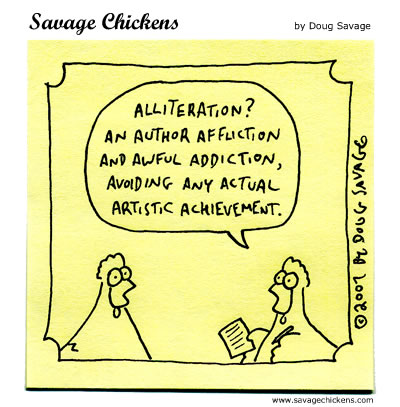
Alliteration
Use of similar consonants: a poetic
or literary effect achieved
by using several words
that begin with the same or
similar consonants, as in
"Whither wilt thou wander, wayfarer?"
Not sure if I was supposed to post this on my blog
but I did it anyway.

or literary effect achieved
by using several words
that begin with the same or
similar consonants, as in
"Whither wilt thou wander, wayfarer?"
Not sure if I was supposed to post this on my blog
but I did it anyway.
Tuesday, November 22, 2011
New BIG Question
How can we study infinity?
How DO we study infinity?
(Thanks Dr. Preston for helping me refine my other question into this one..)
How DO we study infinity?
(Thanks Dr. Preston for helping me refine my other question into this one..)
Sunday, November 20, 2011
Literature Analysis #3
The Picture of Dorian Gray by Oscar Wilde
1. Dorian Gray is a well cultured and a very handsome young man living in London, England. The commoners and the wealthy are intrigued with his beauty and perfect appearance—he can attract males as well. An artist named Basil Hallward [Basil is homosexual like Oscar Wilde, the author (he incorporated himself in the novel]) finds Dorian Gray as a perfect subject for a new painting and paints him. After the painting of the perfect Dorian Gray was finished, the painted was handed down to its rightful master. As time passes, Dorian’s internal ugliness begins to show in the portrait while his actual self never ages and remains flawless. Needless to say Dorian is a very arrogant and narcissist towards himself and when a girl whom she loved broke her heart and committed suicide, Dorian still lead a life of a steel heart. When she died, the portrait contained a scratch. At the end of the novel when Dorian is a disgusting person at heart, the portrait turns into a repulsive man and he calls up the artist, Basil, and asks what he has done to the painting. Basil told him he has never touched the painting but Dorian can’t accept it. Instead he stabs him with a knife and kills him. Worried, Dorian black mails a friend to dispose Basil Hallward’s body. After that event the portrait is at its most hideous point. Dorian Gray is furious and stabs the portrait at the heart. Soon, the maids in the mansion hear a loud shriek of a man. They curiously enter Dorian’s room and find a gorgeous and spotless painting of a handsome young man and on the floor is an old man with a knife in his heart.
1. Dorian Gray is a well cultured and a very handsome young man living in London, England. The commoners and the wealthy are intrigued with his beauty and perfect appearance—he can attract males as well. An artist named Basil Hallward [Basil is homosexual like Oscar Wilde, the author (he incorporated himself in the novel]) finds Dorian Gray as a perfect subject for a new painting and paints him. After the painting of the perfect Dorian Gray was finished, the painted was handed down to its rightful master. As time passes, Dorian’s internal ugliness begins to show in the portrait while his actual self never ages and remains flawless. Needless to say Dorian is a very arrogant and narcissist towards himself and when a girl whom she loved broke her heart and committed suicide, Dorian still lead a life of a steel heart. When she died, the portrait contained a scratch. At the end of the novel when Dorian is a disgusting person at heart, the portrait turns into a repulsive man and he calls up the artist, Basil, and asks what he has done to the painting. Basil told him he has never touched the painting but Dorian can’t accept it. Instead he stabs him with a knife and kills him. Worried, Dorian black mails a friend to dispose Basil Hallward’s body. After that event the portrait is at its most hideous point. Dorian Gray is furious and stabs the portrait at the heart. Soon, the maids in the mansion hear a loud shriek of a man. They curiously enter Dorian’s room and find a gorgeous and spotless painting of a handsome young man and on the floor is an old man with a knife in his heart.
2. Internal ugliness will show. This is the simplest theme I could come up with in the novel. Dorian Gray was handsome and attractive but his heart was disgusting and horrifying. The painting that Basil painted was a symbol of this heart. I believe that is why when Dorian stabbed the painting, it actually stabbed his heart.
3. Oscar Wilde’s tone was very calm but mystifying. His use of syntax and diction made the novel much more compelling and dramatic. [Some of the things he says are quite philosophical.]
‘Dorian Gray lifted his golden head from the pillow, and with a palid face and tear-stained eyes looked at him, as he walked over to the deal painting-table that was set beneath the high curtained window.’
‘All art is quite useless.’
‘Life always has poppies in her hands.’
4. Oscar Wilde has to be one the best authors that use imagery—it is amazing how a simple few words can turn a mind full of vibrant images. Again, syntax and diction added to the richness of the novel. Reading his imagery passages was like taking a decadent bite of rich chocolate—the more we taste, the more sensation and thoughts we get. Sounds funny, but it was like this while reading.
‘The studio was filled with the rich odor of roses, and when the light summer wind stirred amid the trees of the garden there came through the open door the heavy scent of the lilac, or the more delicate perfume of the pink-flowering thorn.’
‘The sullen murmur of the bees shouldering their way through the long unmown grass, or circling with monotonous insistence round the dusty gilt horns of the straggling woodbine, seemed to make the stillness more oppressive.’
‘Harry, imagine a girl, hardly seventeen years of age, with a little flower-like face, a small Greek head of passion, lips that were like the petals of a rose. She was the loveliest thing I had ever seen in my life. .. Pathos left you unmoved, but that beauty, mere beauty, could fill your eyes with tears.’
Wednesday, November 16, 2011
The BIG question
Is there really a reason why we are all living?
Why is there life?
What's the purpose?
How...did we get here?
Why is there life?
What's the purpose?
How...did we get here?
Tuesday, November 8, 2011
Essay...
<'cuse my most generic title...>
One of the most recognizable quotes of American literature, “To be, or not to be”, is quoted by Prince Hamlet from Shakespeare’s play Hamlet. The philosophical and intricate mind of Hamlet differs significantly from other heroes of epics or stories. For instance, King Beowulf was a charismatic leader who believed peace and power were superior in comparison to Hamlet’s belief about revenge and mind. The interesting part about Hamlet is that he is characterized by the other character’s action—it almost seems like Hamlet is not a protagonist because his role is transparent yet significant. Beowulf on the other hand is a much more dramatic character whose role in the story is very hero-like and show traits that conveys to the readers that he is suited for a king. Hamlet differs from other protagonists or heroes in stories due to his portrayal in the play and his battling mind with revenge, love and chaos.
Most heroes we think of are strong, wise, powerful, and charismatic and many others however Hamlet doesn’t fit to any of these criteria. Although he is wise and a plan maker, his actions don’t show directly whereas Beowulf’s actions and plans are clear to the readers. “Why then, ‘tis none to you, for there is nothing either good or bad but thinking makes it so. To me, it is a prison.” The readers have to get inside Hamlet’s mind when deciphering each and every line he states like in his famous soliloquy. Beowulf is a fearless leader; “I’ve never known fear, as a youth I fought in endless battles. I am old, now, bit I will fight again, seek fame still, if the dragon hiding in his tower dares to face me.” A line like this would never sputter out from Hamlet’s mouth; they are much too dissimilar in terms to behavior, emotion and action.
“…And boasting of how brave we’d be when Beowulf needed us, he who gave is these swords and armor: all of us swore to repay him.” What a line—no character in Hamlet would dare to say something so intrepid such as this line in Beowulf. It’s not part of Hamlet’s nature to be so loved and adored by his fellow lover and “friends” and family. Askew from Hamlet, nobody would even say this to King Claudius, let alone any other male characters in the play. Of course anyone in the story could say these things but the stress lies in the words themselves.
Hamlet fights with his intellectual mind more than anything, he doesn’t physically fight except the time him and Laertes played with swords. Beowulf is all about the “action” and typical heroism that is usually followed by a happy ending—yuck. A tale of great misfortune is more compelling. Anyway, Hamlet was a man of delicate intricacies and controversial but philosophical mind. Beowulf on the other hand was not much of an outstanding character because not much can differentiate him from heroes from other stories and epics. “…That I ever I was born to set it right! Nay, come, let’s go together.”
Monday, November 7, 2011
Subscribe to:
Posts (Atom)